
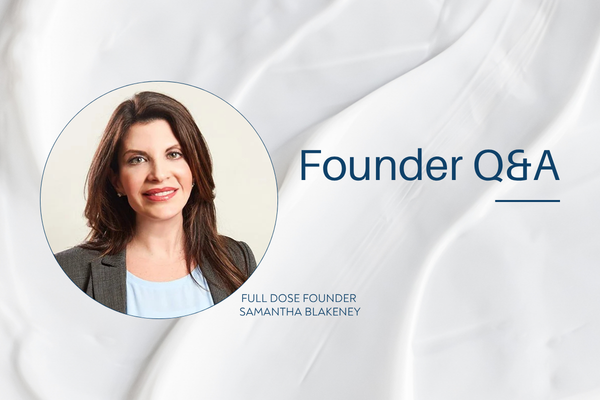
With more than two decades in the skincare industry, Samantha Blakeney has built a successful career at the intersection of science, innovation, and product development. We caught up with Samantha to talk about her path to founding Full Dose, what the industry gets wrong, and a few lessons learned along the way.
On Building Businesses and Brands
Your career in skincare began somewhat unexpectedly. How did it lead to Full Dose?
Everyone in this industry was “inspired” or has a “passion.” I was not inspired as much as presented with an opportunity to transition from a marketing role into a sales role when my sister helped me secure an interview for a sales position at a private-label skincare company. I ended up loving it and performing well — it was probably the happiest accident I have ever experienced, as I am still in this space more than 20 years later. Then, in 2011, I was helping a rep educate a pharmacist about a hair-growth product line she and I worked for. During that time, I befriended the pharmacist, and we have built a massive compounding business over the past 15 years.
Full Dose is the convergence of all my work experience and competencies. It just made sense to create an umbrella organization that covers private label, manufacturing, OTC, prescriptions, and backbar skincare and supplements.
What developments in skincare science excite you most?
The evolution of delivery systems, drone technology, and the current trend back to simplicity and science.
Where do you see the greatest opportunity for the aesthetics industry to improve?
Just as other industries struggle with providing excellent service and a client-centric approach, the aesthetics space is no different. A human response from someone who is not only knowledgeable and qualified but also timely and responsive is an anomaly. Full Dose is scaffolded with excellent client care, attention to detail, and clear communication.
What’s something the skincare industry gets wrong?
There is really not a dupe for every skincare product, and there aren’t just a “few companies” making skincare (meaning every white cream is from the same lab with a different bottle).
In the case of boutique brands, it’s extremely challenging to determine who the manufacturer is, but people claim to have this knowledge all the time. They are usually wrong! Furthermore, just because an ingredient list is similar, that does not make a product a dupe. There are processes in product manufacturing that can greatly alter the structure of molecules. Delivery systems determine whether a product is penetrating the epidermis and working on a cellular level. The order in which actives are added to a batch and the temperatures during mixing can also completely alter the chemistry by inactivating an ingredient or causing a change in pH.
How do you separate promising innovations from passing trends?
Science and information sources. If there is nothing in the medical literature (not ChatGPT or Google) to support results, then I get curious. If there is abundant anecdotal evidence from licensed aesthetic and medical professionals, real human before-and-afters, and/or reproducible results, then innovation may be a reality.
Social media and other online outlets are rife with information, claims, and users being "obsessed" with a product, and this should give us pause. Often, when money is changing hands, it is a transaction, not scientific or reputable evidence.
What advice would you give to someone launching a skincare brand?
Start by solving a problem for the people you serve or the audience you are targeting. Some of the most innovative products in history were developed to solve a problem. Penicillin was discovered nearly a hundred years ago to combat infections that were lethal at the time but are completely manageable today. Anesthesia was created to allay excruciating surgical pain. We could not imagine our lives without these discoveries.
I do realize skincare is not as serious as lethal bacteria or life-saving surgery, despite what the influencer of the moment may have us believe, but filling a gap and addressing a need with a product backed by science will yield success. The client or patient will be pleased, and they will return for more. This builds loyalty, increases engagement, and fosters trust.
What’s the most rewarding part of bringing a brand to life?
Back when people used to shop in brick-and-mortar stores, I had multiple experiences of unexpectedly seeing a newly launched brand on display. These were custom formulations I had worked on for over two years. Seeing the consumers' excitement and the sales associates enthusiastically and accurately educating them was surreal. The first time this happened, I was in Nordstrom. I pretended to be browsing and waited to see if they made a purchase — and they did. It was very exciting.
More recently, I had a similar experience when a new client shared that they were inspired by a brand I had a hand in creating (without knowing I did, because discretion is paramount!). In general, seeing all of the hard work, determination, and innovation come together as something people want and need is very powerful and motivating.
What’s next for skincare? Any emerging trends you’re watching?
It is hard to predict, but a trend that I see excitement around and quick adoption of is the crossover of skincare and lifestyle. Skincare brands are creating fun lifestyle products. Dior has a medallion lip balm that sticks to the back of a cell phone. It’s very similar to the Rhode lip gloss phone case from a few years ago. Givenchy created lipstick hairpins, and Fenty has keychains, hoodies, and LED makeup mirrors. To me, these products provide deep brand immersion, engagement, and loyalty.
Beyond the Business
What does your ideal day off look like? Who are you spending it with?
A softly structured day that starts with a seriously strong latte, physical activity, plans to go out, and going to bed at a reasonable time.
I work from a solo office, and my team is all remote, so being out in the world and interacting in real life is very appealing. I'd spend it with my inner circle of family and close friends.
What’s a family lesson that’s stayed with you in business?
No one cares! This phrase may seem negative, but it's actually aspirational. The gist is that no one is paying as close attention as we think they are, so do not bother worrying about what "they" think. When this attitude is supported by hard work, honesty, integrity, a willingness to learn, and thoughtfulness, success is imminent.
How about a business lesson that’s shaped your personal life?
Active listening is not a trend. It is mandatory for all successful relationships. The importance of paying attention to tone, inflection, patterns, and word choice cannot be overstated. Hearing is a passive, involuntary, physiological function; it is not listening. Listening is a conscious, intentional, and active skill. I work at being a good listener. It takes practice.
What’s captured your attention outside of work lately?
As a quinquagenarian, I have been bullied long enough about eating more protein. I found this wonderful woman, Madelaine Rascan, online. Her app is full of the most delicious and easy recipes. I batch cook, and now, I am hitting all of my protein goals. What felt impossible is now actually happening. I seriously cannot believe it.
What’s your skincare active alter ego?
Retinoids are my personality in an ingredient because they are proven to work hard, are tactfully honest, are not afraid to get messy, and deliver glowing, long-term results — as long as you stick with them.
Contact us today to explore formulation options and learn how we can support your skincare product offerings with unique and impactful science-backed actives.